Appreciation/Depreciation Quiz
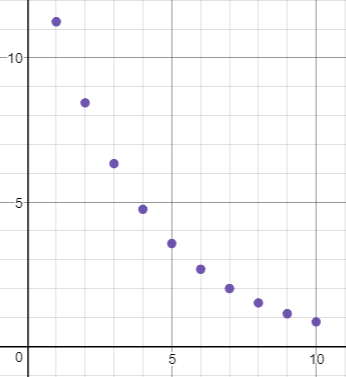
1. Which of the following terms best describes the function above?
2. Given the exponential function \(P=150(1.9)^t\) where P represents a population and t represents a number of days. What does the value of 1.9 in the function tell you?
3. Given the exponential function \(P=150(1.9)^{\frac{t}{7}}\) where P represents a population and t represents a number of days. Which of the following must be False?
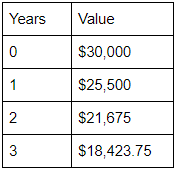
4. Ryan bought a car and the table above shows how the value of that car changes over a 3 year period. Which of the following descriptions best describe the function above?
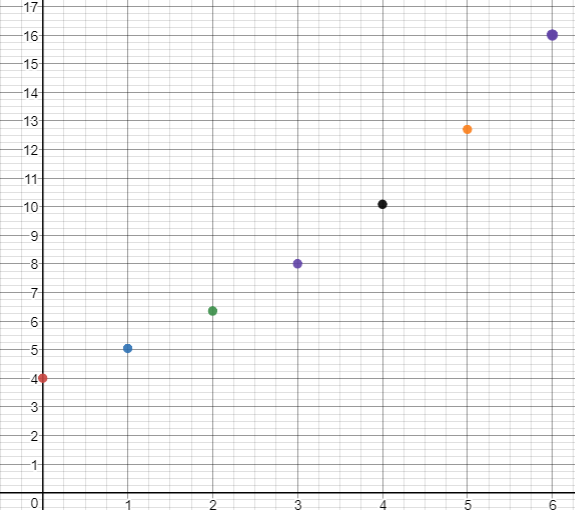
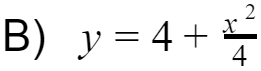
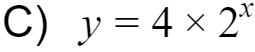
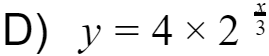
5. Which of the following equations best represents the information above?

| 6. x | y |
| 2 | 207 |
| 3 | 621 |
| 4 | 1863 |
| 5 | 5589 |
| 6 | 16767 |
If the exponential function takes the form \(f(x)=f(0)(1+r)^x\) , what is the value of \(r\)?
Student Response
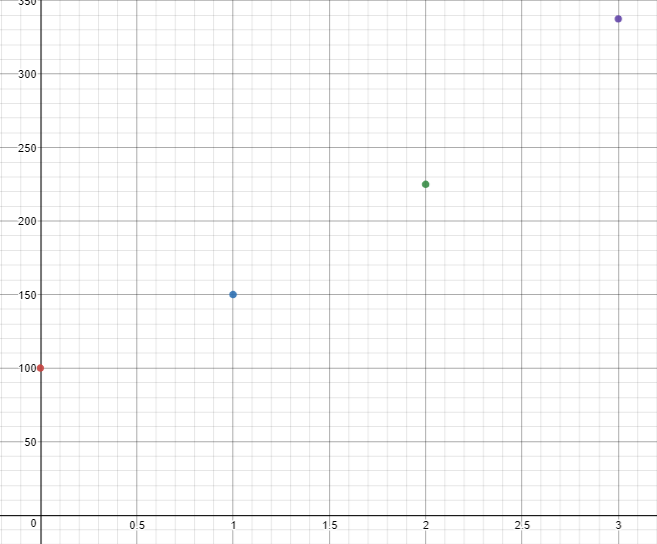
Questions 7 and 8 refer to the following information.
If the graph above is modelled on the function \(y=ab^x\).
7. What is the value of \(a\)?
8. What is the value of \(b\)?
Questions 9, 10 and 11 refer to the following information.
The population of bacteria (b) obsevred in a petri dish over time (t) can be modelled by the equation below:
\(b=1000000(0.8)^t\)
9. How many bacteria are there in the beginning?
10. Will the bacterial number increase or decrease?
11. What was the rate of growth/decay as a percentage?
12. Find the compound interest payable when $4200 is invested for 3 years at 7% per annum.
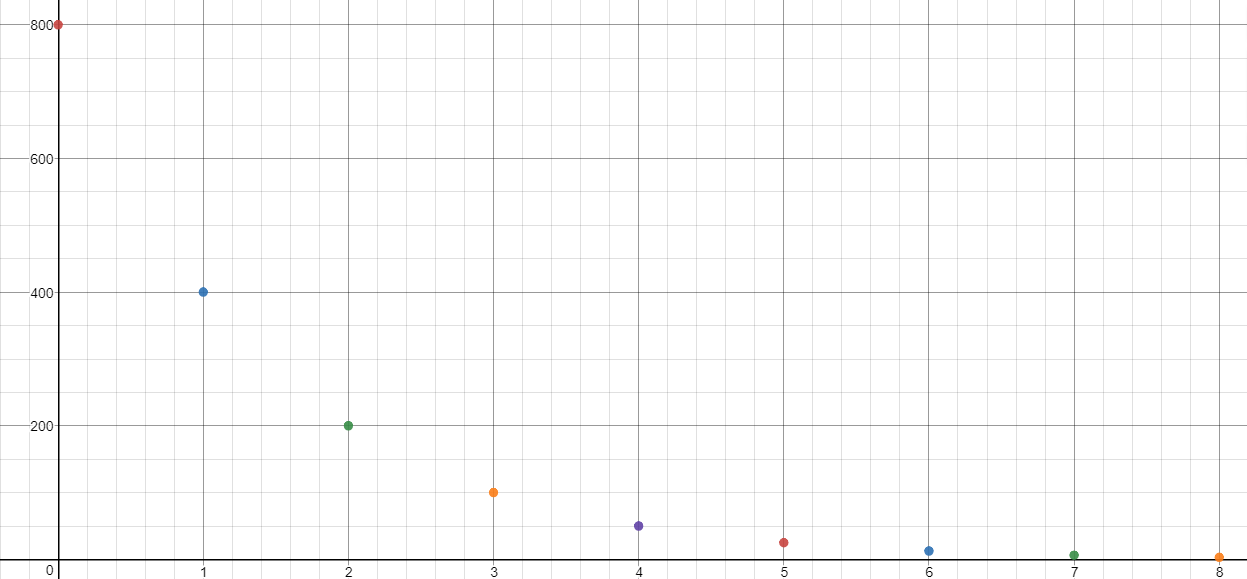
13. If the graph above is modeled on \(y=ab^x\), what is the value of \(b\)?